

Below Is a FREE TO DOWNLOAD audio about Hemp, Geopolitics, and the Global Race for Sustainable Power.
Hemp, Geopolitics, and the Global Race for Sustainable Power
Written by Casper Leitch
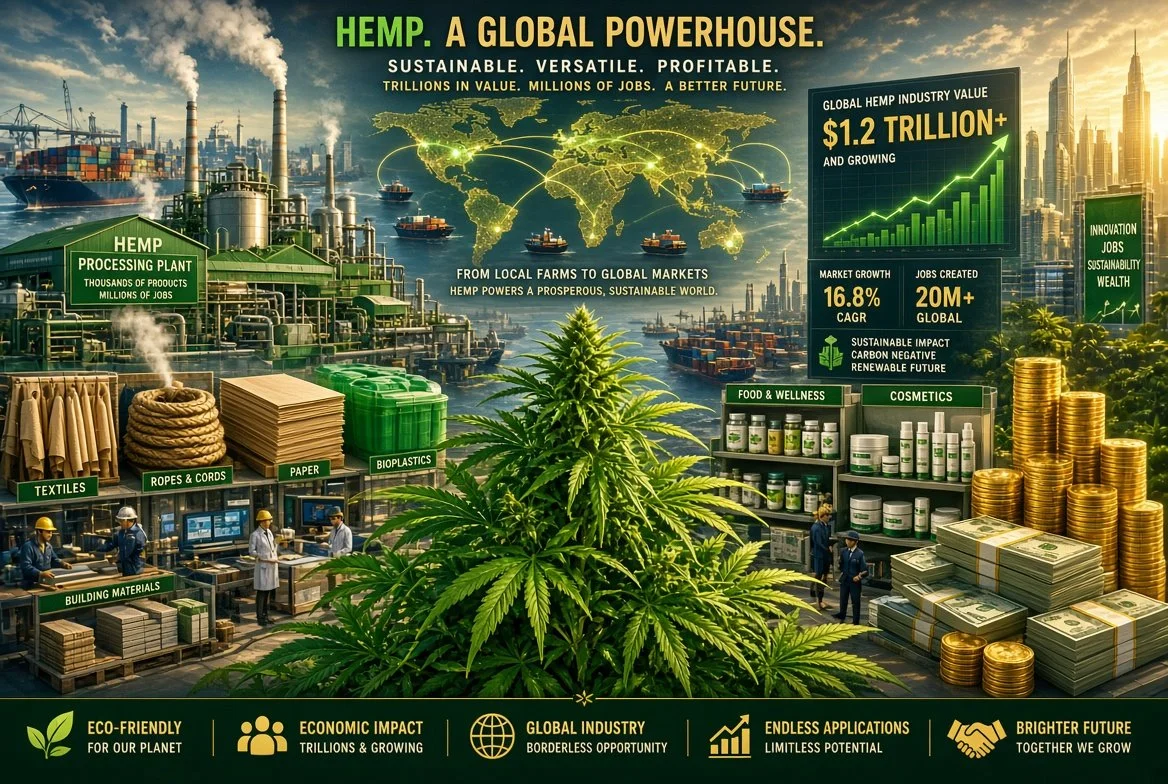
When we talk about hemp’s future, it’s easy to imagine it as a domestic story: American farmers, American factories, American sustainability goals. But the truth is much bigger. Hemp is becoming part of a global competition, a geopolitical race shaped by climate pressures, industrial innovation, and shifting international alliances. And just like in the Age of Sailing, nations are once again looking at hemp not simply as a crop, but as a strategic resource.
To understand this new era, we have to start with the global climate crisis. Countries around the world are under pressure to reduce emissions, rebuild supply chains, and transition to sustainable materials. Traditional industries (construction, textiles, plastics, automotive manufacturing) are being forced to rethink how they operate. In the search for alternatives, hemp is one of the most promising natural materials available.
Europe moved first. The European Union began investing heavily in hemp research, focusing on engineered textiles, bio-plastics, and carbon‑negative construction materials. France, long a leader in hemp fiber production, expanded its processing infrastructure. Germany and the Netherlands began testing hemp composites for automotive parts. Spain and Portugal explored hempcrete for climate‑resilient housing. The EU’s harmonized 1.0% THC limit created regulatory stability, allowing companies to scale production across all borders.
China moved next and moved fast. Already the world’s largest producer of hemp textiles, China expanded industrial hemp processing at a scale few countries can match. Its factories produce fiber, yarn, bio-composites, and hemp‑based plastics for global export. Chinese researchers are studying hemp cellulose for advanced materials, including biodegradable packaging and high‑strength composites. In many ways, China is positioning itself to dominate the global hemp supply chain the same way it dominates solar panels and rare‑earth minerals.
Canada followed with a different strategy. It focused on food, wellness, and agricultural science. Canadian hemp seed oil, protein powders, and nutraceuticals entered global markets. Universities studied hemp’s role in regenerative agriculture and carbon sequestration. Canada’s approach was less about industrial dominance and more about agricultural innovation; but it still placed the country at the center of global hemp cannabis research.
Australia and New Zealand entered the race through construction. Facing extreme climate conditions, they began testing hempcrete for fire‑resistant, mold‑resistant, and energy‑efficient housing. Their governments funded pilot projects to explore hemp’s role in climate‑resilient architecture. In regions facing drought, hemp’s deep root system offered agricultural stability that other crops could not match.
And then there is the United States, a country with enormous potential, but still deciding how aggressively it wants to compete. America has the land, the universities, the manufacturing capacity, and the entrepreneurial culture to become a global hemp leader. But it also has regulatory complexity, fragmented state laws, and a legacy of prohibition that slowed early development. While Europe built fiber mills and China built factories, the U.S. spent its first years of legalization navigating CBD booms, market crashes, and inconsistent rules.
Yet despite these challenges, something important is happening. American corporations are beginning to see hemp not as a niche material, but as a strategic asset. Automotive companies are testing hemp composites for electric vehicles. Construction firms are exploring hempcrete for low‑carbon building projects. Textile brands are developing engineered hemp blends for mainstream fashion. Packaging companies are experimenting with hemp bio-plastics to meet sustainability mandates. In other words, the U.S. is entering the race and it’s entering at a moment when global demand is accelerating.
This brings us to the geopolitical dimension. As nations compete for sustainable materials, hemp is becoming part of climate diplomacy. Countries are negotiating trade agreements that include hemp fiber, hemp seed, and hemp‑based materials. International standards are being developed for THC limits, fiber quality, and environmental certification. Hemp is appearing in discussions about carbon credits, regenerative agriculture, and global climate targets.
In some regions, hemp is even becoming part of national security planning. Countries are studying hemp’s role in supply‑chain resilience, especially for materials that could replace petroleum‑based plastics or carbon‑heavy construction products. Just as naval stores once shaped the rise of empires, sustainable materials may shape the balance of power in the 21st century.
And hemp is uniquely positioned in this landscape. It grows quickly. It absorbs carbon. It regenerates soil. It can be used for textiles, plastics, construction, food, wellness, and advanced materials. Few crops offer that combination of versatility and sustainability. But the global race also raises questions. Who will control the supply chain? Who will set the standards? Who will dominate the markets? Will the United States build the infrastructure needed to compete with Europe and China? Will farmers have access to stable markets? Will corporations invest in long‑term hemp innovation?