
Part 3 - Hemp Helped Build The United States
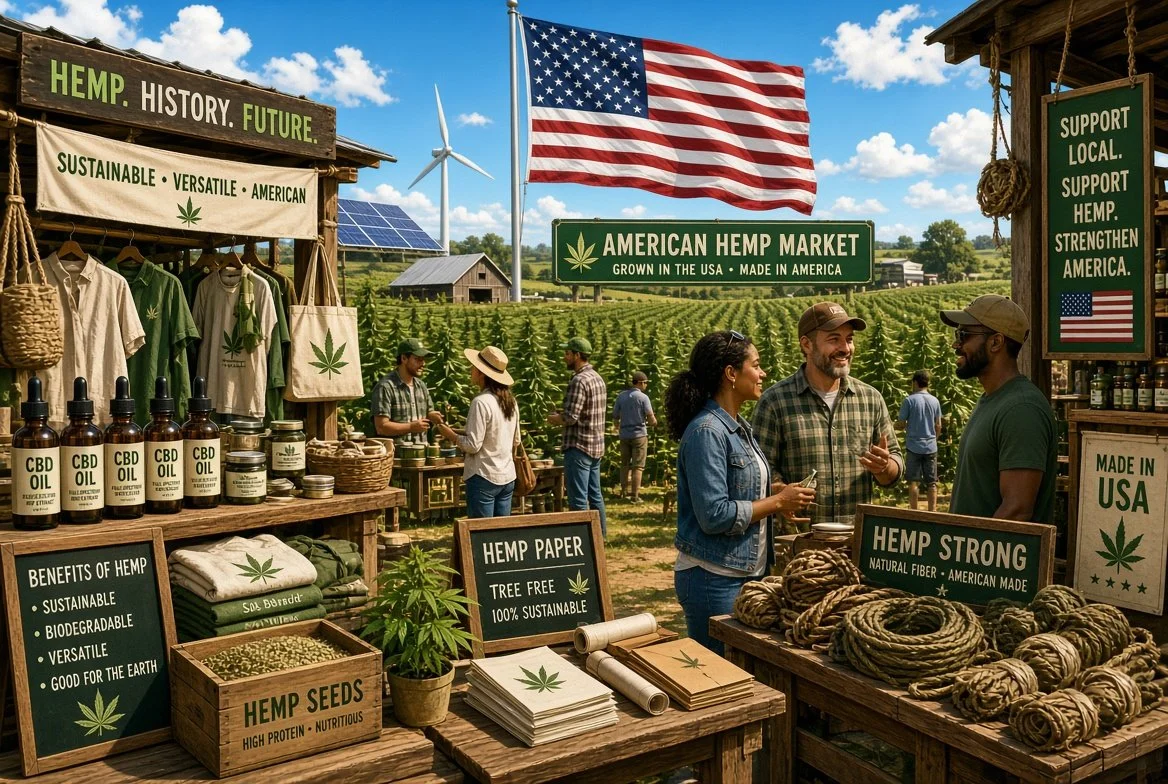
Below Is a FREE TO DOWNLOAD audio about hemp’s place in building America’s future.
Hemp In The Next American Century
Written by Casper Leitch
When we look back across the long arc of hemp history, from colonial rope-walks to Kentucky plantations, from Revolutionary supply chains to World War II factories, one pattern becomes clear. Hemp rises whenever the country faces a moment of transition. It rises when old systems break down. It rises when new industries need new materials. It rises when the nation must rethink how it builds, trades, and survives.
And today, in the early 21st century, America is facing another one of those moments.
Climate pressures are reshaping global manufacturing. Corporations are searching for low‑carbon materials. Farmers are looking for resilient crops. Governments are rewriting environmental policy. And consumers are demanding products that reflect their values. In this landscape, hemp is not returning as a nostalgic symbol of the past. It is emerging as a strategic material for the future.
The first major frontier is advanced materials. Hemp fiber is being engineered in ways that early Americans could never have imagined. Scientists are breaking down hemp cellulose and rebuilding it into composites that rival fiberglass. Automotive companies are testing hemp panels that are lighter, stronger, and more sustainable than traditional plastics. Packaging companies are experimenting with hemp bio-plastics that biodegrade without leaving microplastic residue. These innovations aren’t theoretical. They’re already appearing in prototypes, pilot programs, and early commercial products.
What makes hemp so promising is its versatility. The plant that once made rope for sailing ships can now be used to create high‑performance composites for electric vehicles. The same fiber that once held cannons in place can now reinforce biodegradable plastics. Hemp is becoming a bridge between old materials and new technologies; a natural resource adapted for a digital, industrial, and climate‑conscious world.
The second frontier is construction. Hempcrete, once a niche curiosity, is gaining serious attention as a low‑carbon building material. It stores carbon, regulates humidity, and provides long‑lasting insulation. Builders are experimenting with hemp‑based wall systems, insulation boards, and structural composites. Engineers are studying hemp’s potential in modular housing, disaster‑resistant structures, and large‑scale commercial buildings. As building codes evolve to meet climate goals, hemp could become a standard material in sustainable architecture.
This is not a small shift. Construction is one of the largest carbon‑emitting industries in the world. If hemp can replace even a fraction of traditional materials, it could reshape the environmental footprint of entire cities. And because hemp grows quickly and regenerates soil, it offers a renewable supply chain that aligns with global sustainability targets.
The third frontier is agriculture. Farmers across the United States are rediscovering hemp not just as a crop, but as a tool for land restoration. Hemp shades out weeds, reduces erosion, and improves soil structure. It grows in diverse climates, from the Midwest to the Pacific Northwest. It requires fewer chemical inputs than many traditional crops. And in regions facing drought, hemp’s deep root system offers resilience that other crops lack.
Agricultural researchers are studying hemp rotations that restore soil health after years of corn and soybean monoculture. They’re exploring hemp’s role in regenerative farming, carbon sequestration, and rural economic revitalization. In states where farming communities are struggling, hemp offers a new path, not a miracle cure, but a practical option with long‑term potential.
The fourth frontier is global markets. Countries around the world are investing heavily in hemp research and production. Europe is developing hemp bio-plastics and advanced textiles. China is expanding hemp fiber processing at industrial scale. Canada is refining hemp food products and wellness supplements. Australia is exploring hempcrete for climate‑resilient housing. The global hemp market is projected to grow dramatically over the next decade, driven by sustainability demand and industrial innovation.
For the United States, this creates both opportunity and competition. America has the land, the research institutions, and the manufacturing capacity to become a global leader in hemp. But it must build the infrastructure: decortication facilities, fiber mills, composite factories, and supply‑chain networks that can support large‑scale production. If the country invests strategically, hemp could become a pillar of American industry once again.
The fifth frontier is science and medicine. While industrial hemp contains low levels of THC, its cannabinoids, terpenes, and plant compounds are being studied for wellness, nutrition, and therapeutic applications. Hemp seed oil is rich in omega fatty acids. Hemp protein offers a sustainable alternative to animal‑based proteins. Researchers are exploring hemp’s potential in anti‑inflammatory products, dermatology, and nutritional science. As medical cannabis research expands, hemp’s non‑intoxicating compounds may play a role in future treatments. But perhaps the most important frontier is identity: how America sees hemp, and how hemp fits into the story of the nation’s future.
For decades, hemp was misunderstood, misclassified, and overshadowed by prohibition. But as legalization spreads and public education improves, Americans are rediscovering hemp’s history and potential. Museums are creating exhibits. Universities are offering hemp courses. Farmers are planting hemp alongside traditional crops. Corporations are integrating hemp into sustainability strategies. And consumers are buying hemp products not because they are trendy, but because they are practical, durable, and environmentally responsible. In this cultural shift, hemp is becoming more than a crop. It is becoming a symbol of innovation and a reminder that the materials of the future may come from the plants of the past.