
President Trump: “Today, I am pleased to announce that I will be signing an executive order to reschedule marijuana from a Schedule 1 to a Schedule 3 controlled substance… we have people begging for me to do this, people that are in great pain.”
Below is a FREE TO DOWNLOAD short report about rescheduling cannabis from One to Three along with two great songs by The Illusions Of Music.
Moving From One To Three!
How President Trump’s Cannabis Decision Could Reshape America’s Hemp and Cannabis Industry
Written by Casper Leitch
President Trump’s long-anticipated executive order directing the federal government to move cannabis from Schedule One to Schedule Three under the Controlled Substances Act marks one of the most consequential moments in modern American drug policy. For hemp activists, cannabis professionals, researchers, and entrepreneurs, this announcement signals both long-overdue progress and a reminder that true reform is still a work in progress.
While the order promises immediate relief in some areas of the cannabis economy, it does not magically undo more than five decades of federal prohibition. Instead, it opens a new chapter. One defined by cautious optimism, regulatory complexity, and a renewed push to finally align science, medicine, and common sense with federal law.
What the Executive Order Actually Does And What It Doesn’t
It is important to understand what President Trump’s December 18, 2025 executive order can and cannot accomplish. Despite popular belief, no U.S. president has the authority to single-handedly rewrite federal drug law. The Controlled Substances Act of 1970 requires that drugs be rescheduled either through a formal rule-making process or by an act of Congress.
President Trump’s order does not instantly legalize cannabis nationwide, nor does it erase federal penalties or allow interstate cannabis commerce. Cannabis would remain illegal under federal law even after rescheduling, and cannabis businesses would still operate within a complicated legal gray area.
What the order does do is direct Attorney General Pam Bondi to take all necessary steps to complete the rescheduling process as quickly as possible and in full compliance with federal law. That directive alone is significant, because it places cannabis reform squarely at the top of the federal enforcement agenda.
Continuing And Accelerating The Biden-Era Process
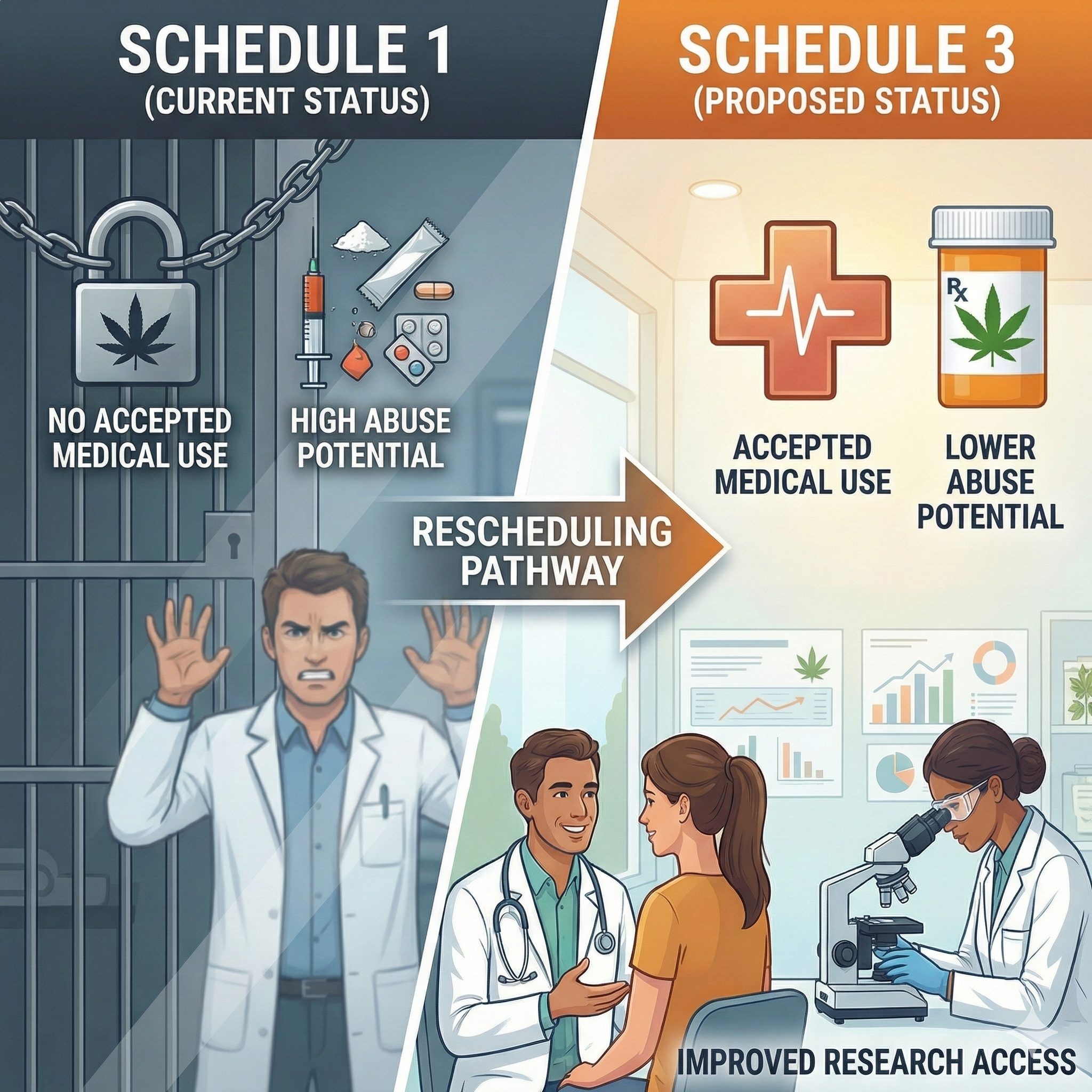
The Trump administration is not starting from scratch. Under former President Joe Biden, the Department of Health and Human Services and the Department of Justice had already advanced a proposal to move cannabis from Schedule One, where it is defined as having no medical value and a high potential for abuse, to Schedule Three.
Schedule Three includes drugs such as Tylenol with codeine, anabolic steroids, and certain prescription anxiety medications. These substances are recognized as having accepted medical uses while still being regulated for public use.
President Trump’s executive order strongly suggests that his administration may resume and accelerate that existing process. Notably, the order references Section 811 of the Controlled Substances Act, which could allow the attorney general to reschedule cannabis without going through every traditional procedural step. This provision was designed to help the U.S. comply with international drug treaties—but it also has historic relevance to cannabis.
In 2018, the same authority was used to place Epidiolex, a cannabis-derived epilepsy medication, into Schedule Five (the least restrictive category) shortly after it became the first federally approved prescription drug derived from cannabis.
A Major Win for Medical Cannabis Research
Scientists and medical professionals have widely welcomed the move toward rescheduling. President Trump has emphasized that this change will support expanded medical research, and for good reason.
Under Schedule One, researchers face extraordinary barriers, including special licensing requirements and restrictive laboratory rules. Moving cannabis to Schedule Three would eliminate the need for a Schedule One research license and significantly reduce red tape.
However, one major obstacle remains: access to research-grade cannabis. While the federal government has expanded the number of approved cannabis suppliers beyond the long-standing University of Mississippi monopoly, researchers are still limited in both product variety and potency. Without broader reforms across federal agencies, cannabis science will continue to lag behind public use and patient demand.
A Lifeline for the Hemp Industry at a Critical Moment
Beyond cannabis, President Trump’s order also throws a critical lifeline to the U.S. hemp industry. The timing could not be more important. In November 2025, a provision slipped into a government funding bill aimed to close what lawmakers described as a “hemp loophole.” Industry leaders warn that this language could effectively ban most hemp-derived consumer products, including full-spectrum CBD, and force thousands of legitimate businesses to shut down.
President Trump’s executive order acknowledges this looming crisis and calls on federal agencies to work with Congress to update the law. The goal is to preserve access to hemp-derived CBD products while restricting items that pose genuine health risks.
This distinction matters. Hemp-derived CBD is legal, non-intoxicating, and widely used by Americans for wellness, pain management, and even hemp products for pets. Full-spectrum CBD contains only trace amounts of naturally occurring THC and does not produce a high.
Hemp, Cannabis, and the Need for Unified Regulation
Hemp was legalized under the 2018 Farm Bill to support agriculture, textiles, and sustainable commerce. However, vague definitions and a lack of federal oversight allowed some companies to exploit loopholes by chemically altering THC or concentrating it in ways that mimic high-potency marijuana.
Critics argue that these practices blur the line between hemp and cannabis, undermining consumer safety and public trust. The funding bill attempts to address this by redefining hemp products containing more than 0.4 milligrams of THC as cannabis rather than hemp.
Industry stakeholders agree that reform is necessary, but warn that overly broad language could unintentionally ban legitimate CBD products, including those used in medical cannabis care for people and cannabis care for pets.
The White House fact sheet reinforces this concern, noting that one in five American adults, and nearly 15 percent of seniors citizens, used CBD products in the past year. Without clear rules, patients, doctors, and retailers are left without guidance or safety standards.
What Comes Next for Hemp and Cannabis Reform
Despite its significance, President Trump’s executive order is not law. It does not instantly reschedule cannabis or rewrite federal statutes. What it does is create political momentum and provide hemp and cannabis advocates with new leverage heading into a critical legislative year.
Industry leaders believe the order strengthens their case to Congress and increases the likelihood of sensible reforms that protect consumers, support research, and allow responsible businesses to thrive.
What is becoming clear is that hemp and cannabis cannot be regulated in isolation. They are deeply connected and require a coordinated, science-based regulatory framework; one that respects medical cannabis, supports innovation, and finally brings an end to outdated hemp prohibition.
For activists, patients, entrepreneurs, and everyday Americans, this moment represents more than a policy shift. It is a reminder that progress happens when advocacy, science, and leadership finally move in the same direction. And while the journey toward full legalization of medical cannabis and adult-use marijuana is far from over, the path forward has never been clearer, or more necessary.
Michael Williamson is joined by cannabis attorney Devon Baxter to cut through the noise around cannabis rescheduling and explain what the shift to Schedule 3 actually means for operators.