
Below Is a FREE TO DOWNLOAD short audio about how hemp helped to build America.
The Founding Fathers Knew Hemp Was Valuable
Written by Casper Leitch
When we talk about the making of the United States, we often focus on the big ideas: liberty, revolution, democracy, and the founding documents. But beneath those ideas was a physical world that had to be built, supplied, and maintained. And one of the most important materials in that world was hemp. Long before cannabis became a political flashpoint, hemp was a strategic industrial crop woven into the daily life, economy, and survival of early America.
To understand how deeply hemp shaped the United States, we have to begin in the colonial era. In the Age of Sailing, empires moved by water, and ships were the engines of global power. Those ships needed rope, rigging, canvas, cordage, and sailcloth; all of which depended heavily on hemp. A ship built between the 1400s and the mid‑1800s was basically a floating machine made from wood, iron, cloth, and miles of rope. Hemp was not optional; it was essential to naval strength, merchant shipping, and imperial expansion.
England’s dependence on Baltic hemp created strategic vulnerability, and Parliament responded by pushing the American colonies to grow their own supply. In 1633, the Virginia House of Burgesses required planters to sow flax and hemp. This wasn’t a suggestion, it was law. Colonists were expected to grow hemp because the empire needed it. And by the early 1700s, Parliament was offering bounties to encourage colonial hemp production, hoping to reduce dependence on foreign markets.
This is where the story begins to shift from global empires to America. The same crop that helped Britain build its navy would soon help the colonies build their independence.
By the mid‑1700s, hemp was so important that many farmers were required to grow it. Historical accounts confirm that in several colonies, landowners were mandated to cultivate hemp or pay fines. In Jamestown, it was required by royal decree that property owners grow hemp for export. Massachusetts and Connecticut enforced similar rules.
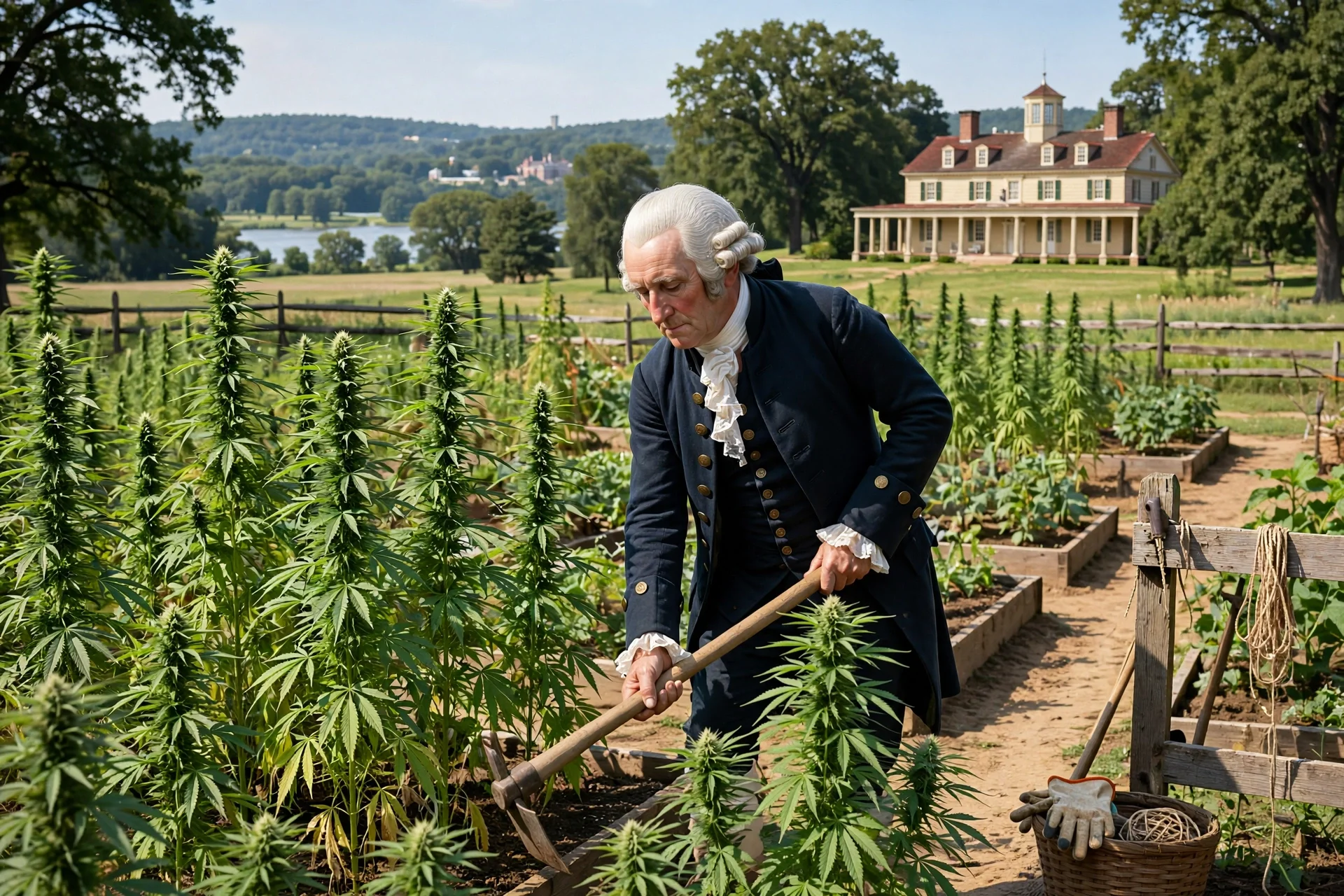
The Founding Fathers were part of this world. George Washington grew hemp at Mount Vernon and even wrote to his London agent asking about prices and profits. Thomas Jefferson experimented with hemp at Monticello. John Adams wrote about hemp’s agricultural value. These men weren’t growing hemp as a novelty, they were participating in a vital economic system that supported rope‑making, textiles, paper, and maritime supply chains.
There is also evidence that hemp could be used to pay taxes in certain regions during the colonial and early national periods. While practices varied by colony, hemp’s role as a staple commodity made it part of local barter economies and tax‑in‑kind systems. Hemp was a practical, valuable raw material deeply integrated into daily life.
As the United States expanded westward, hemp followed. Nowhere was this more visible than Kentucky. According to historical records, Kentucky became the nation’s leading hemp producer by the 19th century, responsible for three‑quarters of all U.S. hemp fiber. The Bluegrass region’s soil and climate were ideal for hemp, and the crop helped make Kentucky one of the wealthiest commonwealths in America. Hemp rope, bagging, and textiles supported agriculture, shipping, and other major industries. Senator Henry Clay, one of the most influential statesmen of his era, was a major hemp grower and a fierce advocate for domestic hemp production. His speeches helped shape national policy, and his estate, Ashland, became a symbol of Kentucky’s hemp economy.
By the late 1800s, hemp production declined as cotton rose and imported fibers like jute entered the market. Industrial changes reduced the need for traditional rope and sailcloth. But hemp’s story wasn’t over. In the 20th century, global conflict brought it roaring back.
During World War II, the United States faced a critical shortage of industrial fibers. The government responded with a national campaign called through a 14-minute film entitled: “Hemp for Victory”. The film urged farmers to grow hemp for the war effort. The United States Department of Agriculture produced the film explaining hemp’s history and showing how it was cultivated and processed into rope, cloth, and cordage. Farmers across the country planted thousands of acres, including more than 50,000 acres in Kentucky alone. Hemp became a patriotic crop, essential for naval equipment, parachute webbing, and military supplies. The Marijuana Tax Act was temporarily lifted to allow production, underscoring how vital hemp was to the national defense of the United States.
After the war, hemp slipped back into obscurity as federal policy shifted toward prohibition. But its legacy remained. Hemp had helped build ships, supply armies, support farmers, and strengthen the economy. It had shaped colonial law, influenced founding leaders, and powered the rise of Kentucky’s agricultural wealth. It had been a strategic resource in both the American Revolution and World War II.
Today, as hemp returns under modern legalization, we are rediscovering a truth that early Americans understood well: hemp is not just a plant. It is a material that helped build a nation. It connected fields to factories, farms to fleets, and local economies to global trade. It was part of the physical infrastructure that allowed the United States to grow, survive, and eventually thrive.
The story is not just about rope and canvas. It is about labor, ambition, policy, and power. It is about how a simple fiber crop became woven into the rise of an empire; and later, the birth of a country determined to chart its own course.